

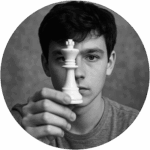
He was already there.
Pieces set. Scoresheet flat. Pen lined up along the edge like it mattered.
I checked the pairing sheet on the wall again before sitting down.
Board seven.
Same.
I had looked at it three times because the name opposite mine belonged higher up. I recognised it from the first round, when I had walked past the top boards pretending to look for the toilet.
Sergio Vidal. Three wins from three. Nearly three hundred rating points above me.
I had two points. One of the players in his score group had withdrawn and the numbers no longer worked. Somebody had to move up from the group below.
That somebody was me.
In a Swiss tournament, players are normally paired against people on the same score. Win your first game and you meet another winner. Keep winning and the boards get closer to the front. Lose and the system moves you towards people having a similar day.
It works neatly until a score group contains an odd number of players.
Then somebody has to float.
I was the upfloat.
The computer had looked at everyone on two points, considered colours and previous opponents and decided I was the least inconvenient person to throw at Sergio.
He hadn’t moved when I got back to the board. One pawn was slightly off centre. He fixed it without looking up.
I sat down and adjusted a knight that did not need adjusting.
The clock was on. I pressed mine once to check it and let it run a second longer than I should have before pressing it back.
Sergio glanced at me for the first time.
“Ready?”
I said yes in a voice that sounded as if someone else had answered.
The arbiter started the round.
Sergio moved straight away. Wrote it down. Pressed the clock.
I looked at the board longer than usual.
Nothing complicated. Just 1.e4.
I knew that. Obviously I knew that. Still, I spent nearly a minute deciding how to answer because answering quickly felt like admitting I was nervous.
I played c5.
Someone walked behind me and stopped near board five. Their shoes dragged slightly on the floor before they moved on.
Sergio did not look up.
His second move came just as fast. Knight to f3. Write. Press.
I had played the Sicilian hundreds of times online. Online, nobody can see you staring at the screen as if the pieces have personally betrayed you.
At a real board, every second feels public.
After six moves, we had a position I recognised. That should have helped. It didn’t. Sergio’s pen stayed in his hand between moves and every piece landed exactly in the middle of its square.
I started wondering what he knew that I didn’t.
That is the first problem with playing someone stronger. You stop looking only at their moves. You start looking for the hidden part.
A pawn move becomes preparation. A pause becomes calculation. If they take longer than expected, you assume they have found something terrible. If they move quickly, you assume the terrible thing was obvious.
Sergio played bishop to e3.
Normal move.
I checked every possible sacrifice anyway.
By move ten I had used twenty-two minutes. He had used six.
I got up.
I walked past board six and then board five. Someone at board four was leaning back in their chair with both hands over their face.
I didn’t go any further. The top boards were only a few metres away but walking towards them felt ridiculous now that I had been temporarily placed among people who belonged there.
When I sat down, Sergio was waiting in the same position.
Not looking at me. Just at the board.
I checked it again.
Same as before.
Still felt like I had missed something.
He had more space. I had a backward pawn on d6 and a bishop that was technically developed but had nowhere useful to go. I could hear Don Emilio describing it as “a position that requires patience”, which is what he says when a position looks unpleasant but is not yet bad enough to complain about.
Then Sergio pushed his f-pawn.
That was the moment I forgot about the rating.
It was an aggressive move and maybe a good one but it left something behind. His king was still in the centre. If I took on e4 and he recaptured, my queen could come to h4 with check.
I calculated it once.
Then again because he was Sergio Vidal and people rated three hundred points above me are not supposed to leave checks lying around.
The line still worked.
I took the pawn.
For the first time all game, he stopped moving quickly.
He leaned forward. Put his pen down. Looked at the kingside and then at me, briefly, as if checking whether I had done it on purpose.
That helped more than it should have.
He recaptured with the knight. I played queen to h4.
Check.
The move did not win anything. It was not brilliant. He blocked with g3 and I moved the queen back. A few moves later the position was roughly equal again.
But the rhythm had changed.
Sergio no longer wrote his moves before reaching for the clock. He thought. I thought. The board became a chessboard instead of a warning.
By move twenty-five we had exchanged queens. My backward pawn was still backward and his bishop was better than mine. I had one open file for my rook and enough activity to be annoying.
He offered a draw on move thirty-one.
I nearly accepted immediately.
A draw against someone much higher rated is supposed to feel like a win. It protects your score and gives you something to mention later without technically boasting.
I looked at the position.
My rook was active. His king was cut off and I could bring my bishop to c5. I wasn’t winning but I wasn’t hanging on either.
“I’ll play a bit,” I said.
Sergio nodded.
Five moves later I regretted it.
He improved his king, attacked the d-pawn and forced my rook away from the open file. The position I had thought was equal began shrinking. Every move had to defend something.
This time I didn’t panic. I traded the weak pawn for his queenside pawn and reached a rook ending with three pawns each.
We played another eighteen moves.
Nobody was watching when we finally agreed the draw. Board seven had stopped being interesting. The winners were gathering near board one and several players had already gone outside.
Sergio signed my scoresheet.
“Good game,” he said.
It sounded ordinary. That was the strange part.
I had spent most of the first hour treating him like a different kind of player. By the end he was just a person trying to make a rook ending do something.
Don Emilio was waiting near the door.
“You drew,” he said.
I handed him the scoresheet.
He looked at Sergio’s rating and then at mine.
“Good.”
“That’s all?”
“You want a parade?”
“I thought you’d be impressed.”
“I am impressed that you declined the first draw.”
“You would have declined it.”
“No,” he said. “I would have taken it and gone for coffee.”
He folded the scoresheet and handed it back.
The next pairings were already being printed. I could hear the machine behind the organiser’s table starting and stopping.
I went over to wait by the wall with everyone else.